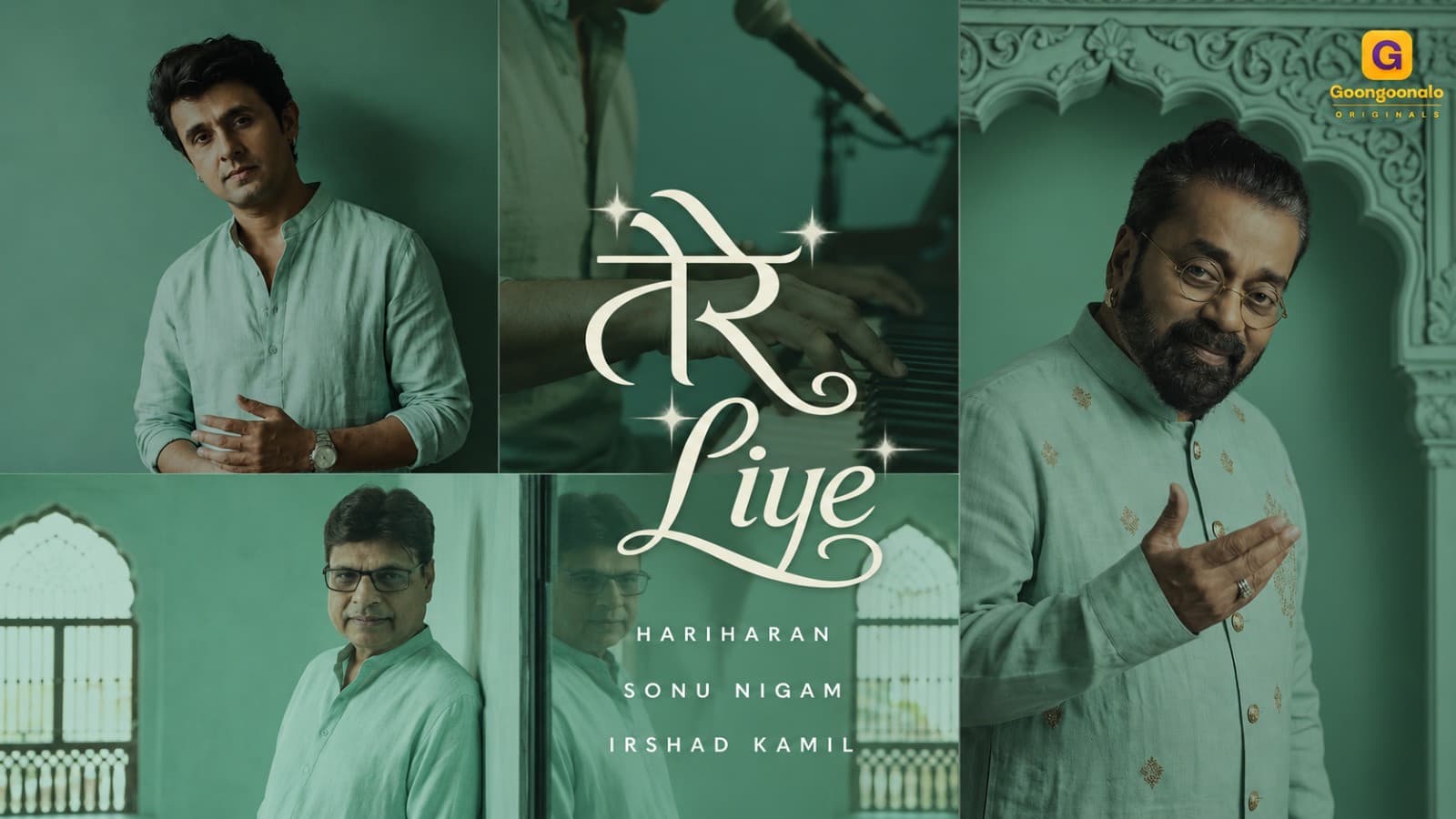
Tere Liye - Sonu Nigam, Hariharan and Irshad Kamil Explore Love That Becomes Devotion
Some songs describe falling in love. Others stay with what happens after love has settled into your life—when someone's presence becomes familiar, necessary and, eventually, almost sacred.
Some songs describe falling in love. Others stay with what happens after love has settled into your life—when someone's presence becomes familiar, necessary and, eventually, almost sacred.
Tere Liye lives in that quieter space.
A Goongoonalo Original, Tere Liye is sung by Sonu Nigam, composed by Hariharan and written by Irshad Kamil. Produced and mixed by Saibu V Simon and mastered by Bijin Mathew, the song brings together three distinctive creative voices around a simple but enduring idea: what happens when love becomes more than an emotion and begins to feel like devotion?
When Love Moves From Aadat to Ibaadat
At the emotional centre of Tere Liye is an idea expressed in Irshad Kamil's words:
Tere liye hai aadat,
Mere liye ibaadat,
Tera aana, tera aana...
The movement from aadat—habit—to ibaadat—devotion—is small in language but enormous in meaning.
It suggests a relationship in which another person's presence has become woven into everyday life. Love here isn't presented through grand declarations. It is found in familiarity: waiting for someone, recognising their arrival, and discovering that what once felt ordinary has acquired extraordinary meaning.
That distinction gives Tere Liye its emotional character.
It also invites a question that listeners may answer differently: When does someone's presence stop being simply part of your life and become something you treasure?
Irshad Kamil and the Power of a Simple Image
Irshad Kamil's (https://www.instagram.com/p/Dc85rlpjfce/?img_index=1) writing often reminds us that emotional depth does not necessarily require complicated language.
Another image in Tere Liye places love against the scale of the world:
Duniya ki ranjishon mein,
Dil khol ke mohabbat,
Tera aana, tera aana...
Against life's disagreements, complications and noise comes the suggestion of loving with an open heart.
Elsewhere, the imagery of a loved one's arrival is compared to raindrops decorating a face:
Jaise baarishon ko chehre pe sajaana...
It is an intimate visual. Rain is temporary; you cannot hold it for long. Yet for those few moments, you can feel it completely.
The lyric doesn't need to explain the emotion. The image does the work.
Hariharan: Creating the Musical Space for the Words
Hariharan's role as composer gives these words their musical world.
You can also watch more of Hariharan's Goongoonalo Original content here: Hariharan’s Goongoonalo Original
With a song built around intimacy, the composition has an important responsibility: it must allow the lyric to breathe.
Rather than treating words and melody as separate elements, Tere Liye demonstrates what can happen when they work together to carry the same emotional thought.
That relationship between lyric and composition is also part of what makes songs interesting beyond the finished recording.
A listener hears one complete experience. Behind that experience are individual creative decisions—a writer finding the right image, a composer finding the musical language for it, and a singer finding the emotional tone that can make both feel personal.
Sonu Nigam and the Intimacy of Interpretation
Sonu Nigam brings the final human dimension to that process.
His performance allows the words to feel addressed to someone rather than merely sung about someone.
That distinction matters.
You can also explore unseen Sonu Nigam videos and moments from the project here: Watch Sonu Nigam’s unseen videos
A love song can be technically beautiful and still remain at a distance. Tere Liye instead seeks intimacy—the feeling that these thoughts belong to one person speaking to another.
It is also why the same song can mean different things to different listeners.
One person may hear romance. Another may remember companionship. Someone else may think of a person whose presence once made ordinary days feel different.
The recording remains the same.
The relationship each listener forms with it does not.
The Story Behind a Song Changes How We Hear It
This is where Tere Liye also reflects a larger idea behind Stories Behind Songs on Goongoonalo.
Streaming made it extraordinarily easy to hear music. But hearing a song and understanding it are not always the same experience.
Who wrote the words?
What idea sits at the centre of them?
Who composed the melody?
What does a singer bring to words that existed before the voice entered the recording?
Knowing those things does not replace the experience of listening. It can deepen it.
As Sherley Singh, CEO of Goongoonalo, explains:
“A beautiful song gives you something to feel, but knowing the thought behind the words can give you something more to carry with you. With Tere Liye, the idea of love moving from habit to devotion is what makes the song worth exploring beyond the first listen. That is what we want Stories Behind Songs on Goongoonalo to do—bring listeners closer to the thought and the people behind the music.”
Three Artists, One Emotional Thought
The collaboration between Irshad Kamil, Hariharan and Sonu Nigam is therefore more interesting when we look beyond the names themselves.
Irshad Kamil gives the feeling language.
Hariharan gives that language a melodic form.
Sonu Nigam gives the melody a voice.
Saibu V Simon's production and mix and Bijin Mathew's mastering contribute to the finished recording listeners ultimately experience.
Each role is different, but the listener receives them together.
Understanding those relationships is one of the pleasures of discovering the people behind a song.
Who Does Tere Liye Make You Think Of?
Perhaps that is the best place to leave Tere Liye.
Not with an explanation, but with a memory.
Who is the person whose arrival can still change the atmosphere of a room for you?
Who turned familiarity into something precious?
And when you hear the difference between aadat and ibaadat, which person comes to mind?
Listen to Tere Liye as a Goongoonalo Original—and continue beyond the recording through Stories Behind Songs, where the words, creators and ideas behind music become part of the listening experience.
Credits
Singer: Sonu Nigam
Composer: Hariharan
Lyricist: Irshad Kamil
Produced and Mixed by: Saibu V Simon
Mastered by: Bijin Mathew
Frequently Asked Questions About Tere Liye
1. Where can I watch more of Hariharan's Goongoonalo Original content?
You can watch more of Hariharan's Goongoonalo Original content on Instagram: Watch Hariharan’s Goongoonalo Original
2. Who sings Tere Liye?
Tere Liye is sung by Sonu Nigam, whose expressive vocal interpretation gives the song its intimate emotional character.
3. Who composed Tere Liye?
The song is composed by Hariharan, who creates the musical setting for Irshad Kamil's lyrics.
4. Who wrote the lyrics of Tere Liye?
Tere Liye is written by acclaimed lyricist Irshad Kamil. His lyrics use simple yet evocative imagery to explore love, familiarity and devotion.
5. What does aadat to ibaadat mean in Tere Liye?
The phrase represents the central emotional idea of the song. Aadat means habit or something that becomes familiar, while ibaadat refers to devotion. In the context of the song, it describes how someone's presence can gradually become something deeply cherished.

.png&w=3840&q=75)